













Fu 89 - 177 NFc 40 - 72 N
TD36 series
Unmatched small package

Semiconductors
Increase throughput and precision of your system
Display
Enhance accuracy and precision with linear motors
Science and aerospace
Improve motion quality for a variety of applications
Machine tooling
Robust solutions for increased speed and precision
Digital cutting
Create modular and high throughput applications
Printing
Increase printing speed and quality using linear motors
Robotics
Integrate compact solutions for guaranteed uptime and high dynamics
Life science
Establish precise and clean integrated solutions
Woodworking
Maximize performance and accuracy for high throughput
Stages and system solutions
Compact integration and high performance for your axis
Vacuum applications
Best performance for clean and vacuum applications

The direct drive technology of a linear motor is a perfect way to enhance productivity, accuracy, and dynamic performance. Direct drive motors eliminate the need for mechanical transmissions like rack and pinion, belts, and speed reducers. Between coil unit and magnets there is no contact, this means no mechanical wear. The technology makes designs slimmer, and modular and reduces costs.

Unmatched small package

Unique low build height

Maximum stroke, Maximum force density

Higher acceleration and improved efficiency

Compact iron core motors for low cost of ownership

For high acceleration, speed and accuracy

Takes your application to a new level

Water cooled to reach even higher continuous forces

Minimal Space. Maximum Impact.

Small but ready to do its job

High continuous force for application with high duty cycles

Compact but unique for high precision applications

Ultimate speed and accuracy where precision counts

Efficient and ready for heavy duty application
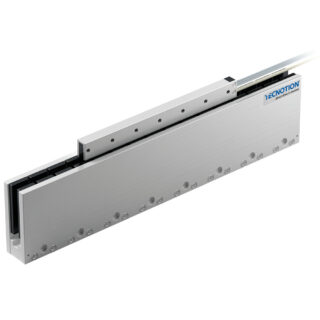
Most robust for maximum force output with ultra precision

High positioning accuracy and repeatability

High acceleration and dynamics

Efficient and with high motor constant
Linear motors are also referred to as direct drive units since the load is directly coupled to the motor. This eliminates the need for elastic components such as gearboxes and couplings, which introduce backlash and error in the motion.
Because these motors do not rely on mechanical drive components such as ball screws, belts, and rack and pinions, linear motors have much higher accuracy and repeatability, with no velocity ripple.
This lack of rotating or recirculating parts also makes them virtually maintenance-free and contributes to a lower total cost of ownership when compared to traditional drive mechanisms.

TD36 series
“Do you have a question about a motor? Or do you need technical support during an installation? Call us and one of our Application Engineers will help and support you throughout the entire process.”
Ask your question

Sign up for our news to receive the latest news and updates from Tecnotion.
