













Methods of commutation
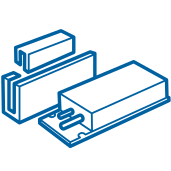
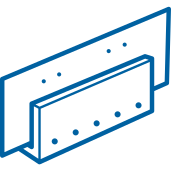
There are a couple of ways to determine the position of (electromagnetic) coils over the magnet-track (or rotor). If the detail and precision of an encoder (ruler) are not needed, an analog hall sensor can be used to measure the position of the coil unit. Digital hall sensores are used to commutate the current.

Advantages and Risks
An easy way to ‘align’ the current though the coils with the permanent magnets is by using a hall-sensor. Hall-sensors can be analog or digital. Analog hall-sensors measure the exact magnet field. The signal will be stronger when centered over a magnet pole. The magnet-field equals zero when measured between two opposite poles. Digital hall-sensors only measure a positive (North) or negative (South) magnet pole. They show a digital readout, meaning a “1” or “0”. When a digital hall-sensor is over a pole of their type (north or south) they give off a signal.

The process of commutation in a synchronous motor is that of switching between the phases. It is possible to switch between the phases in such a way that the winding will alternately attract and repel the permanent magnets to create the desired motion through Lorentz Law. Tecnotion Iron Core, Ironless and Torque motors are all 3-phase synchronized motors.
By alternating the current, the direction of the magnet field in the coils is reversed. The interaction of this magnetic field with the permanent magnet track (or rotor) creates motion.